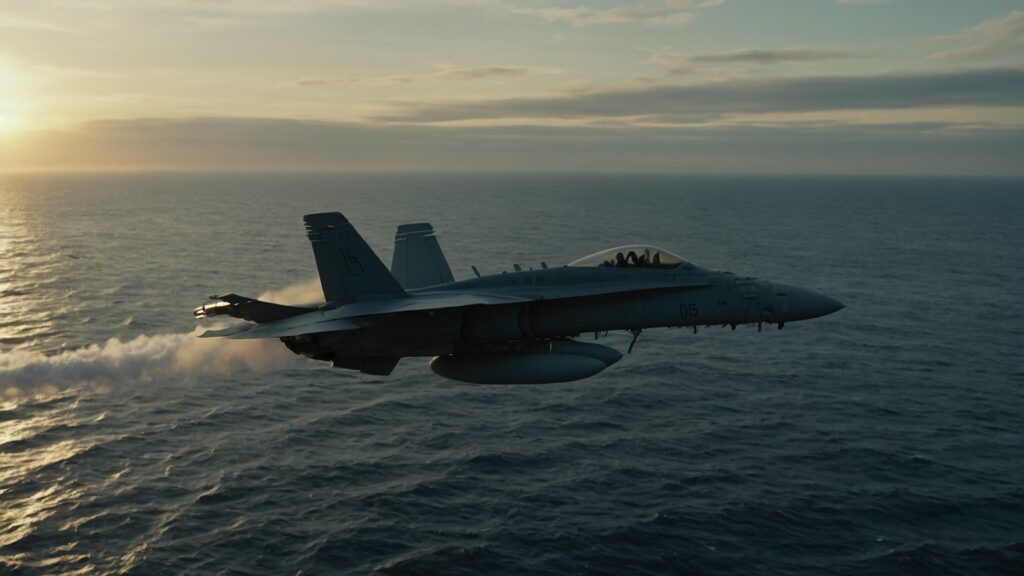
On November 14, 2004, Commander David Fravor watched a forty-foot white object hover motionless above the Pacific Ocean off the coast of San Diego. It had no wings. No exhaust. No visible means of propulsion. The water below it churned in a perfect circular disturbance the size of a Boeing 737. When Fravor maneuvered his F/A-18 Super Hornet toward it, the object mirrored him — then accelerated to a position 60 miles away in less than a minute.
The Pentagon would deny the encounter happened for thirteen years.
The Setup
The USS Nimitz Carrier Strike Group was conducting a pre-deployment workup off the coast of Baja California, roughly 100 miles southwest of San Diego. The exercise was routine. The threat radar operator on the USS Princeton — a Ticonderoga-class guided missile cruiser equipped with one of the most sophisticated naval radar systems in the world — was about to make it anything but.
For nearly two weeks leading up to that morning, the Princeton’s AN/SPY-1 radar had been tracking objects that should not have existed. They appeared at 80,000 feet, dropped to 20,000 feet in a fraction of a second, then descended to sea level and vanished. They moved at speeds that would have torn any known aircraft apart. They emitted no thermal signature consistent with a propulsion system.
Princeton’s senior chief, Kevin Day, would later state the obvious: nothing in the inventory of any nation on Earth could do this.
The Intercept
At approximately 11:00 AM local time on November 14, the Princeton diverted two F/A-18F Super Hornets from a training mission and vectored them toward one of the objects.
Commander David Fravor — Commanding Officer of Strike Fighter Squadron VFA-41, the Black Aces — was lead. His wingman, Lieutenant Commander Jim Slaight, flew on his right. They had no weapons loaded. This was a training flight.
When they arrived at the coordinates and looked down, the ocean below was boiling.
A circular disturbance roughly the diameter of a Boeing 737 churned the surface, white water foaming in a pattern that suggested something massive was just below the waterline. Hovering directly above this disturbance, at approximately 20,000 feet of altitude, was the object.
Fravor described it later in congressional testimony: smooth, white, no markings, no wings, no nacelles, no exhaust ports, no visible cockpit. Roughly 40 feet long. Shaped, in his words, like a Tic Tac.
Fravor began a descending spiral toward the object. The object began to ascend, mirroring his approach as if anticipating his trajectory. When Fravor cut across its path, it suddenly accelerated — and was gone.
Not gone toward the horizon. Gone instantly.
The CAP Point
The two Super Hornets were vectored back to their Combat Air Patrol point — a pre-designated waypoint 60 miles away — for a regroup.
Before they arrived, the Princeton radioed: the object was already there. Waiting.
By the time Fravor and Slaight reached the CAP point, the object had departed again. They had been outpaced by an order of magnitude no known aircraft could match. The implication, if real, was that the object had traveled the distance in less than 60 seconds — a velocity in the high three-digit Mach range, in atmosphere, without producing a sonic boom or thermal bloom.
The FLIR Video
Later that same day, a second sortie was launched. Lieutenant Chad Underwood, also flying an F/A-18F, was equipped with an Advanced Targeting Forward Looking Infrared (ATFLIR) pod and tasked with capturing thermal imagery.
He got it.
The 76-second video — known officially as FLIR1, and unofficially as “the Tic Tac video” — would become one of the most analyzed pieces of military footage in modern history. It shows a smooth, oblong object holding position against the wind, the ATFLIR’s automatic target lock acquiring it cleanly, and then — in the final seconds — the object accelerating laterally out of frame at a velocity the targeting system cannot track.
The video was authentic. The metadata was authentic. The pilot was authentic. And for thirteen years, the Pentagon would refuse to confirm any of it.
The Silence
The Nimitz incident generated a classified after-action report. According to multiple personnel who saw it, the report was comprehensive — documenting the radar tracks from the Princeton, the visual encounter, the FLIR footage, the corroborating Hawkeye E-2C airborne radar contact, and the testimony of all involved aviators.
The report was filed. Then it disappeared.
Senior officers who were there have stated on the record that copies of the report were collected by individuals identifying as belonging to a Defense Intelligence Agency program — and that the original digital files were wiped from Nimitz CSG systems within days.
The FLIR1 video leaked to the public in 2007. It was largely dismissed as a hoax.
The Cascade
On December 16, 2017, The New York Times published a front-page story titled “Glowing Auras and ‘Black Money’: The Pentagon’s Mysterious U.F.O. Program.”
The story revealed the existence of the Advanced Aerospace Threat Identification Program (AATIP) — a classified $22 million Pentagon initiative that ran from 2007 to 2012. It also confirmed that FLIR1 was authentic, that the Nimitz incident had occurred as described, and that two additional Navy videos — known as GOFAST and GIMBAL — existed and were similarly unexplained.
In April 2020, the Department of Defense officially released all three videos.
In June 2021, the Office of the Director of National Intelligence delivered the first Preliminary Assessment on Unidentified Aerial Phenomena to Congress. It documented 144 incidents involving U.S. military personnel between 2004 and 2021. Of those, 143 remained unexplained.
In July 2023, David Grusch — a former intelligence officer who served on the Pentagon’s UAP Task Force — testified under oath before the House Oversight Committee that the U.S. government has been operating a multi-decade program to retrieve and reverse-engineer non-human craft, and that the existence of this program had been concealed from Congress.
The Nimitz incident is the foundational case in the modern UAP disclosure timeline. Every official confirmation, every congressional hearing, every legislative provision in the 2024 NDAA on UAP transparency — all of it traces back to a forty-foot white object hovering over the Pacific Ocean on a clear morning in 2004.
What It Means
The technical impossibilities of the Tic Tac encounter remain the part of the story no government statement has addressed. The object exhibited five capabilities no known aircraft — classified or otherwise — possesses:
- Instantaneous acceleration at rates that would liquefy any biological pilot.
- Zero observable propulsion — no exhaust, no thermal signature, no acoustic signature.
- Trans-medium operation — comfortable transitioning between air, space, and water.
- Apparent anticipation of pilot maneuvers, suggesting awareness or threat-response systems beyond passive detection.
- Radar/visual signature mismatch — appearing solid to optical observation but inconsistent on radar.
If the object was a foreign adversary’s classified prototype, it would mean that nation has been twenty-plus years ahead of U.S. aerospace capability for two decades and has elected not to deploy that advantage strategically. If it was domestic, it would mean the Pentagon investigated, denied, then publicly authenticated its own classified program — a sequence that makes no operational sense.
The third possibility is the one Commander Fravor stated on the record, under oath, before the United States Congress:
It wasn’t ours. And it wasn’t theirs.
The Open Question
The Pentagon has acknowledged the encounter. The pilots have testified. The footage has been authenticated. The radar tracks have been documented.
What was the object?
Twenty-two years later, the answer is still classified.