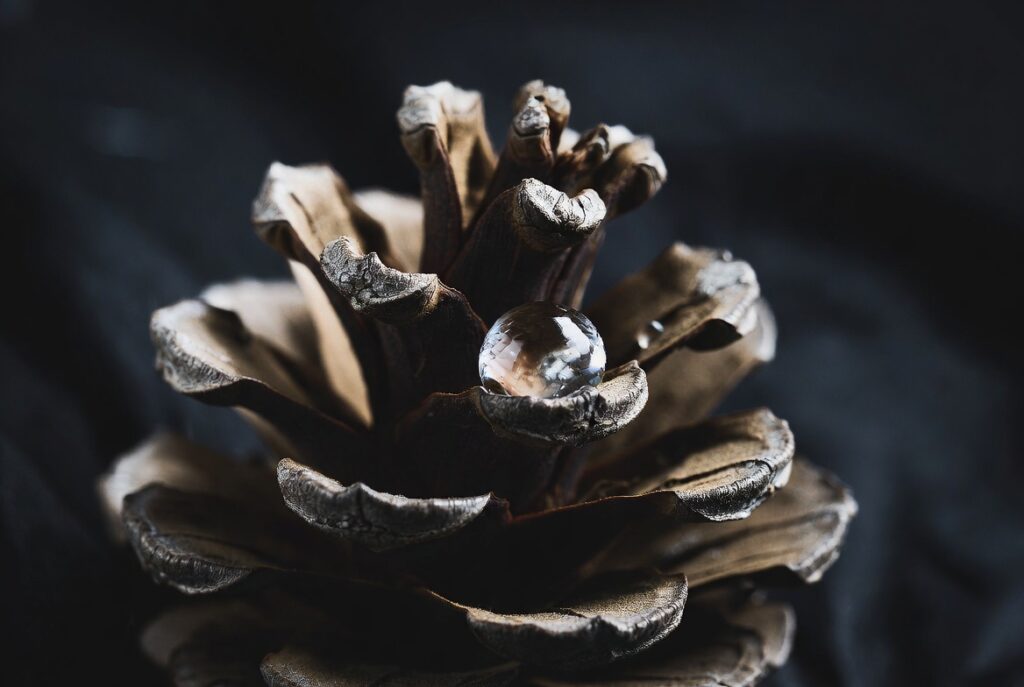
The pineal gland is a small, pinecone-shaped endocrine gland located near the geometric center of the brain, between the two hemispheres, in the epithalamus. It is the only unpaired midline structure in the brain — and the only brain structure that sits outside the blood-brain barrier, meaning it is directly exposed to chemicals carried in the bloodstream that the rest of the brain is shielded from.
Mainstream physiology assigns the pineal three confirmed roles:
- Melatonin production — regulating sleep-wake cycles and circadian rhythm
- Reproductive timing — influencing the onset of puberty and seasonal reproductive cycles in many mammals
- Light sensitivity — responding to photic cues passed from the retina via the suprachiasmatic nucleus
Independent research adds two proposed functions that mainstream medicine has not confirmed but has not disproven: Endogenous DMT production — Dr. Rick Strassman’s research at the University of New Mexico hypothesized the pineal as the source of N,N-dimethyltryptamine, the most potent psychedelic compound known. The hypothesis is contested but not falsified.
Photo-spiritual perception — the “third eye” tradition found in Hindu, Buddhist, Egyptian, and Mesoamerican spiritual systems, all of which assign the pineal a perceptual role beyond conventional senses.
In 1997, Dr. Jennifer Luke completed a doctoral thesis at the University of Surrey titled The Effect of Fluoride on the Physiology of the Pineal Gland. Her finding: the pineal gland accumulates fluoride at higher concentrations than any other soft tissue in the body. Within the calcium hydroxyapatite crystals produced by the gland, she measured a mean fluoride concentration of approximately 9,000 ppm, with one sample reaching 21,000 ppm. By comparison, fluoride in human muscle averaged under 1 mg/kg. Luke’s hypothesis: this accumulation triggers premature calcification of the pineal. Calcified tissue cannot produce melatonin efficiently. The implications, if accurate, extend from sleep disorders to early-onset puberty to suppressed production of any other biochemical the pineal generates.
Luke’s research has been cited in subsequent peer-reviewed literature, including a 2020 review in Applied Sciences that described the pineal as “the most fluoride-saturated organ of the human body.” The implications have not been aggressively pursued by mainstream medicine, for reasons that are political as much as scientific — fluoride’s role in municipal water has been contested for decades, and research challenging its safety profile tends to draw institutional resistance.
Beyond fluoride, several other factors are implicated in pineal calcification:
- Phosphates — soft drinks, processed foods, food preservatives
- Aging — pineal calcification is well-documented as a marker of biological age, visible on standard CT and MRI scans
- Chlorine — tap water disinfection byproducts
- Mercury — dental amalgams, some seafood, certain older vaccine formulations
- EMF exposure — proposed but not conclusively established
- Fringe protocols for “decalcifying” the pineal gland circulate widely. They typically include:
- Fluoride-free water (reverse osmosis or distilled)
- Iodine supplementation (Lugol’s solution or potassium iodide) — peer-reviewed support exists for iodine’s ability to displace fluoride and bromide from tissues
- Vitamin K2 (MK-7) — peer-reviewed support exists for K2 directing calcium toward bone rather than soft tissue
- Boron — proposed to chelate fluoride compounds
- Meditation and breath practices — proposed to stimulate pineal activity directly
Of these, iodine and vitamin K2 have established peer-reviewed mechanisms; the pineal-specific protocols built around them are not clinically validated. Use judgment, and consult a physician before making significant supplement changes. What’s striking is the convergence. The pineal sits in the geometric center of the head. It is the only brain structure with direct exposure to the bloodstream. It is pinecone-shaped — a fact reflected in symbolic iconography across cultures that had no contact with each other:
- The Staff of Osiris in Egyptian iconography, topped with a pinecone
- The Pigna, an 8-foot bronze pinecone displayed in the Vatican’s Court of the Pinecone
- The Sumerian Annunaki reliefs depicting figures carrying pinecones
- The Hindu ajna chakra, the “third eye” located between the brows
- The Mesoamerican staff of Quetzalcoatl, again topped with the pinecone form
None of these cultures had MRI. All of them somehow knew where to point.